


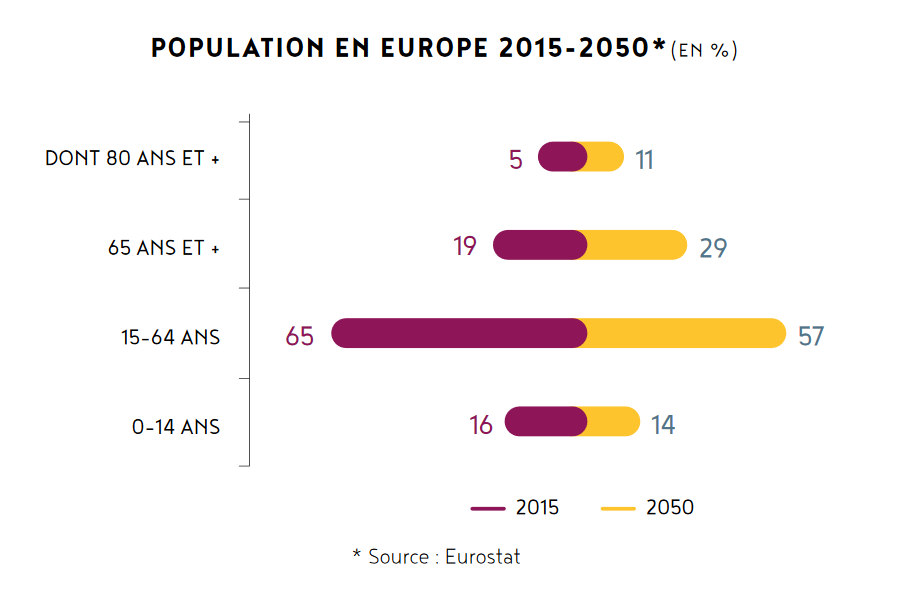
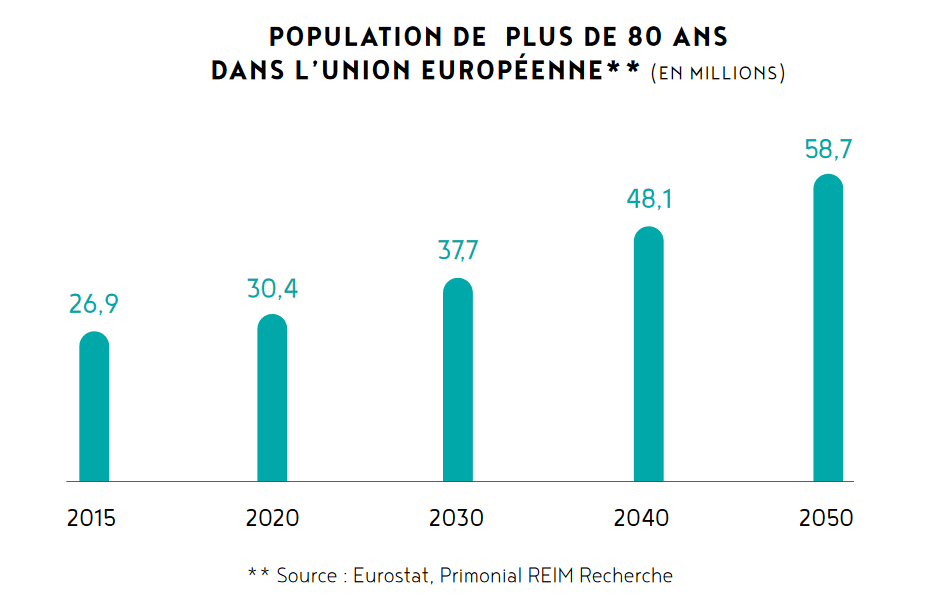
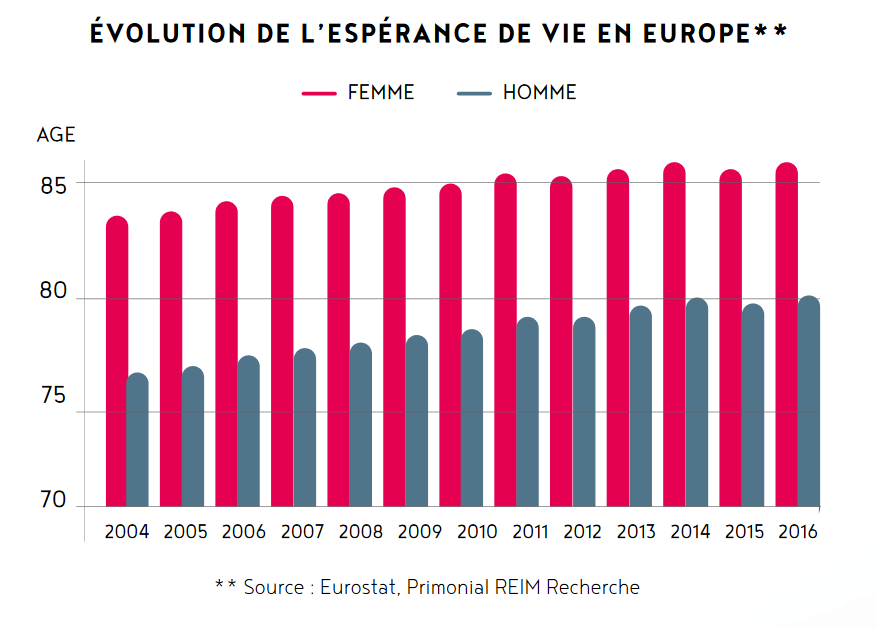
Progress in healthcare and better living conditions are likely to increase life expectancy leading to an increase in the average age of the population that will become an irreversible trend.
As the population gets older, the number of dependent aged people is clearly going to increase too. Consequently, this loss of autonomy must be met with suitable support and/or care.
The team

Henry-Aurélien Natter joined Praemia REIM as Research Manager in January 2018. He has the mission of developing the analyses of the Research & Strategy Department on the real estate markets, the economy and capital in France and in Europe.
Henry-Aurélien Natter began his career at Les Echos Etudes (formerly Eurostaf), then at C&W (formerly DTZ), and lastly at BNP PRE, where he acquired solid and varied experience in real estate research, strategy and finance. He is qualified with an AES degree in Business Management, a Masters Decree in management and SME management, and an International Master in commerce and marketing.

- Thematic study
REAL ESTATE CONVICTION - Q3 2026
INTERNATIONAL ENVIRONMENT: the economy has proved resilient, but the choices ahead will be decisive in shaping the growth outlook. Although global economic activity has proved resilient, repeated geopolitical disruptions have had adverse effects, mitigated by technological advances and adaptation measures. Global growth is therefore expected to slow to 3.1% in 2026 before rebounding to 3.4% in 2027.
- Thematic study
REAL ESTATE CONVICTION - Q2 2026
INTERNATIONAL ENVIRONMENT: THE CONFLICT IN THE MIDDLE EAST IS FUELLING UNCERTAINTY AND VOLATILITY Despite the ceasefire signed in early April 2026 between Iran and the United States, the situation remains fragile and the consequences of the conflict, particularly on the energy markets, could continue to have an impact for several months.
- Thematic study
REAL ESTATE CONVICTION - Q1 2026
INTERNATIONAL ENVIRONMENT: THE CONFLICT IN THE MIDDLE EAST IS FUELLING UNCERTAINTY While the market appeared to have entered a recovery phase at the end of 2025, with momentum expected to carry into 2026, confidence has been dampened by the outbreak of tensions in the Middle East. Despite the ceasefire signed in early April 2026 between Iran and the United States, the situation remains fragile, and the consequences of the conflict, particularly on energy and food markets in the near term, could continue to be felt for several months.
 et Firefox
